 Mainel Studio
The Science Behind Memory Pulse
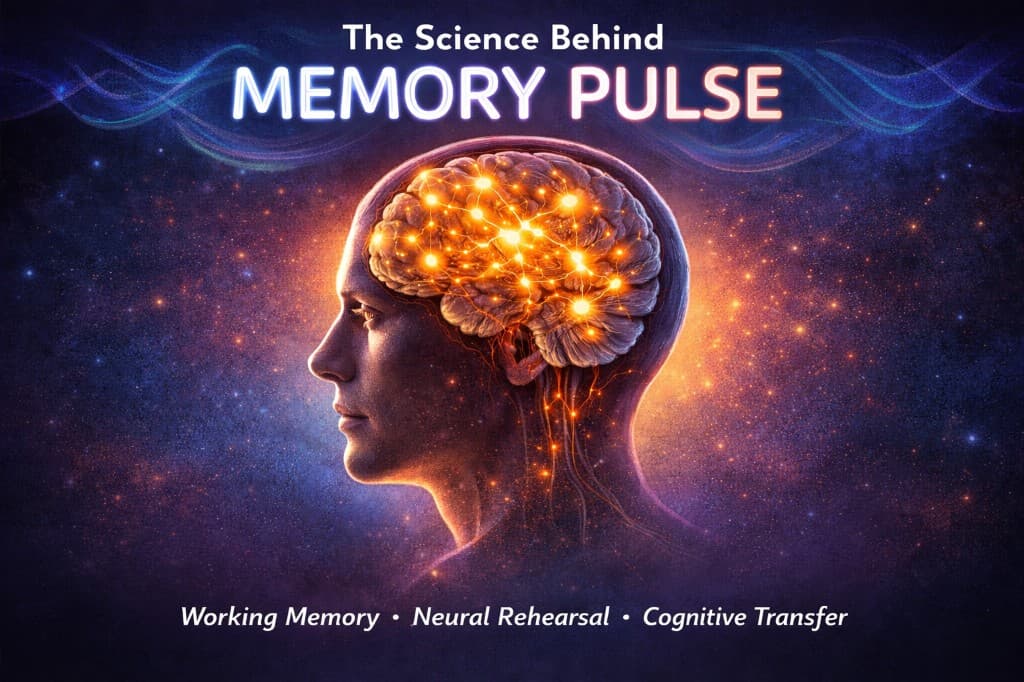
You tap a color. Then two. Then five. Then eight.
At some point your brain stops “thinking” and starts doing something closer to feeling, as if the sequence lives somewhere beneath conscious thought. If you’ve played Memory Pulse (or any Simon-style game), you know exactly what that moment feels like.
But what’s actually happening in your brain when you chase longer and longer sequences? Turns out, neuroscience has a lot to say about it.
Working Memory: The Mental Sticky Note
Every time you watch a sequence and try to hold it long enough to repeat it, you’re exercising your working memory: the part of your brain that temporarily holds and manipulates information you need right now.
Think of it as a mental sticky note. Not permanent, not deep storage. Just a scratchpad for the present moment.
Research by psychologist George Miller established that the average person can hold roughly 7 items (±2) in working memory at once. Some people max out at 5. High performers push past 9. And like any cognitive ability, it responds to training.
That’s where games like Memory Pulse come in.
What Research Says About Simon-Style Games
A study published in the Journal of Science and Technology analyzed Simon’s Game specifically as a cognitive training tool. Their findings? As sequences grew longer, the cognitive challenge became more engaging, and participants who played regularly showed improvements not just in the game itself, but in everyday memory tasks like recalling shopping lists, phone numbers, and academic material.
Researchers call that cognitive transfer, and it’s the real prize: the mental skills sharpened inside the game actually carry over to real life.
What Harvard Researchers Discovered
In a study by researchers at Massachusetts General Hospital and Harvard Medical School, participants played a Simon-style game while brain activity was monitored via implanted electrode arrays. After gameplay, during rest periods, their brains spontaneously replayed the sequences they had just learned, sometimes faster and sometimes slower than the original.
This neural rehearsal during rest and sleep is thought to be a mechanism for converting fragile short-term memories into more durable ones. In other words: your brain keeps practicing even after you put your phone down.
The More You Play, The More Your Brain Adapts
A 2025 meta-analysis published in the Journal of Pharmacy and Bioallied Sciences reviewed randomized controlled trials on brain training games and found consistent evidence that they improve working memory and cognitive processing speed in healthy individuals, across both younger and older adults.
The finding that stood out: people who started with lower baseline cognitive performance showed the greatest improvements. So if you feel like your memory is slipping, that’s precisely when these games are most effective.
What This Means for Your Daily Game
Every time you open Memory Pulse and try to beat your personal best sequence, you’re not just playing a game. You’re running a cognitive workout with decades of neuroscience backing it.
The daily challenge format matters here too. Consistent, repeated training is what drives adaptation. Researchers compare it to physical exercise: a single session helps, but showing up daily is what actually changes the brain.
And the worldwide leaderboard? That’s your benchmark. Your sequence length isn’t just a score. It’s a measurable indicator of where your working memory stands today, and how far you’ve come.
Sources
- Miller, G. A. (1956). The magical number seven, plus or minus two: Some limits on our capacity for processing information. Psychological Review, 63(2), 81–97.
- Taghi Pour Javan, A., Abedi, A., Hassan nattaj, F., & Dehghani, M. (2023). Designing, Developing, and Cognitively Exploring Simon’s Game. FTSCL, Vol. 1, No. 3. fmdbpub.com
- Eichenlaub, J-B. et al. (2020). Replay of learned sequences in human brain during rest. Cell Reports. (Massachusetts General Hospital / Harvard Medical School)
- Somaa, F. et al. (2025). Efficacy of Brain Training Games on the Cognitive Functioning, Working Memory and Processing Speed of Healthy Individuals: A Meta-Analysis. Journal of Pharmacy and Bioallied Sciences. pmc.ncbi.nlm.nih.gov